
Orange Wine: Trendy Fad or a True Colour of Wine?
You see it more and more at trendy wine bars and wine shops. Its amber colour intrigues, its name raises questions. Is orange wine a blend? A failed rosé? Here is everything you need to know about the mysterious "fourth colour" of wine.
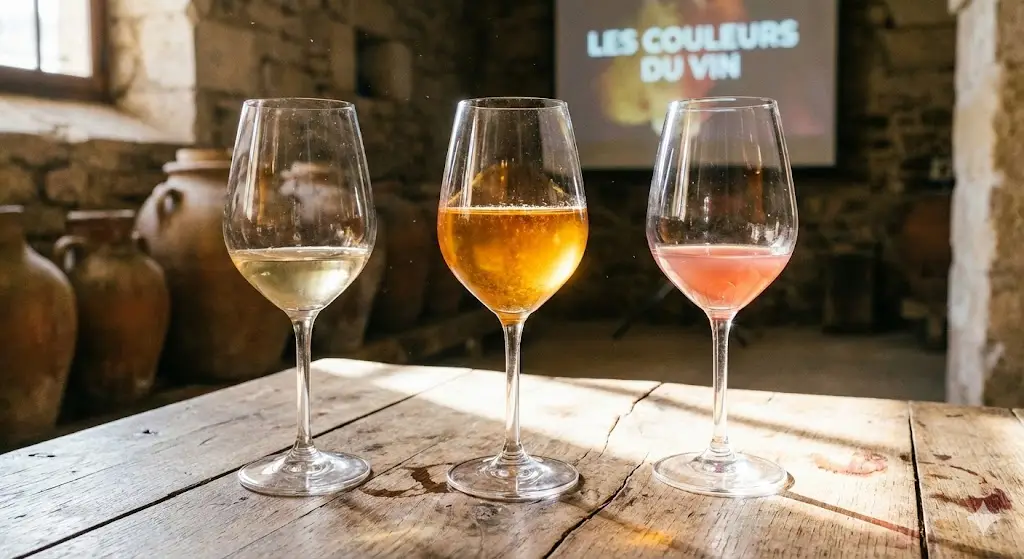
You see it more and more on the menus of trendy wine bars in Lyon and at independent wine shops. Its amber colour intrigues. Its name raises questions.
Is it a blend? A failed rosé? A citrus-flavoured drink? Not at all. Orange wine is a category in its own right, with a millennia-old history and a specific winemaking technique that we break down in our educational journey.
Welcome to the “fourth colour” of wine.
Orange Wine Is… Red Wine Made with White Grapes!
To understand orange wine, you need to go back to the basics of winemaking, as explained in our “From Vine to Wine” module:
- To make white wine, you press the (usually white) grapes and immediately separate the juice from the skins. Only the juice ferments.
- To make red wine, you leave the juice to macerate with the (black grape) skins during fermentation. It is the skin that gives colour and tannins.
And orange wine? It is an ingenious hybrid. The winemaker uses white grapes (such as Chenin or Gewurztraminer), but vinifies them like a red wine. Instead of pressing immediately, the skins are left to macerate in the juice for several days — or even several weeks.
Why That Amber Colour?
It is not a colourant, nor an accidental oxidation. It is this extended maceration with the skins that tints the wine. The pigments contained in the white grape skin diffuse into the juice, giving it a robe ranging from deep gold to coppery orange, sometimes even amber.
Watch out for the trap: “Orange wine” has nothing to do with the fruit! It contains no oranges. The name comes solely from the colour produced by the maceration process.
A Technique as Old as the World (Almost)
If orange wine seems “trendy” today, it is actually one of the oldest winemaking methods in the world. It was born in the Caucasus, in Georgia, over 5,000 years ago.
There, traditionally, wine was not stored in stainless steel vats or oak barrels, but in large clay jars called Qvevri, buried underground to maintain a stable temperature.
Today, this method is making a comeback, particularly among “natural” winemakers seeking rawer, less filtered, and highly expressive wines.
What Does It Taste Like? The Sensory Experience
This is where orange wine surprises the most.
- On the nose: Powerful aromas of tea, dried fruits, spices, or citrus zest are common.
- On the palate: This is where the real shock happens! Unlike a classic white wine that plays on acidity, orange wine has structure. The presence of skins brings tannins — that slightly grippy sensation typical of red wines.
It is a wine made for gastronomy, capable of standing up to spiced dishes, aged cheeses, or Asian cuisine — where a classic white wine would simply fade away.
In Summary
Orange wine is the freshness of white with the structure of red. It is a wine that challenges habits — sometimes a little hazy (often unfiltered), but offering a truly unique experience.
Want to visualise the process? In our room dedicated to vinification, you can use our interactive terminal to compare, step by step, the birth of a white, a red, a rosé… and an orange wine. You will finally understand why the colour of the grape does not tell the whole story!
👉 Come and test your knowledge at Le Petit Musée du Vin in Lyon.