
The Incredible Story of the “Ugly Duckling” That Became the Prince of Beaujolais
Often dismissed as the grape of Beaujolais Nouveau, Gamay actually hides a turbulent history and a royal genetic heritage. From its banishment by a Duke to its DNA-proven kinship with Chardonnay — it is time to rehabilitate this misunderstood variety.
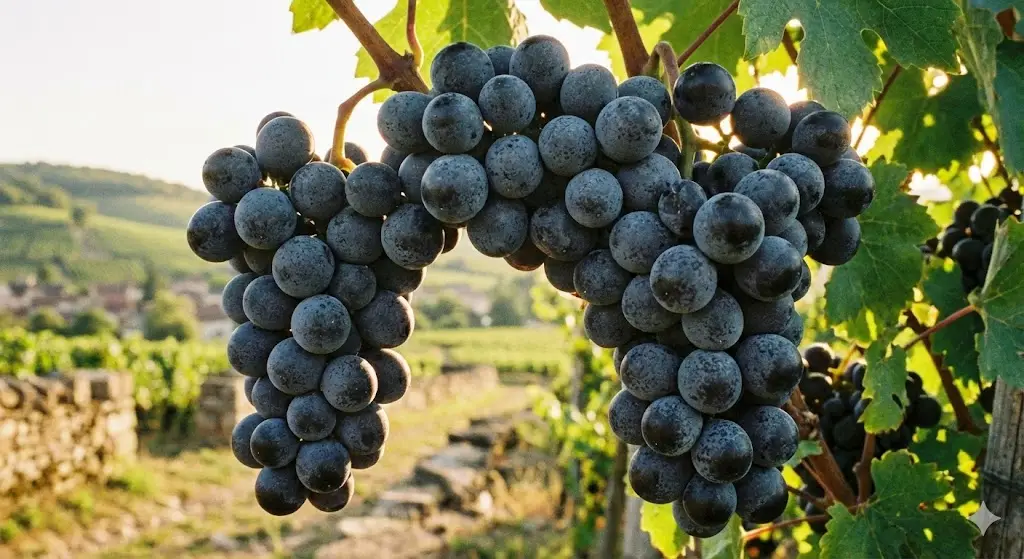
Right on the doorstep of Lyon, Beaujolais is often considered our “backyard vineyard.” Its reigning grape variety? Gamay noir à jus blanc.
Often reduced to the festive image of “Beaujolais Nouveau,” this grape variety actually hides a turbulent history worthy of a TV drama — and a genetic nobility that science took centuries to reveal.
At Le Petit Musée du Vin, we love breaking down received ideas. Today, let’s rehabilitate the Gamay!
“A Very Bad and Disloyal Plant”: The Scandal of 1395
This is a delightful piece of history we tell on our interactive terminals. Gamay was not always welcome in its native lands.
In the Middle Ages, Gamay was planted in Burgundy alongside Pinot Noir. But in 1395, the Duke of Burgundy, Philip the Bold, made a radical decision. He judged Gamay “too productive” and harmful to the region’s reputation.
Unlike Pinot Noir, deemed noble, Gamay was accused of diluting quality. The Duke ordered its mass uprooting and banishment! Driven from the limestone soils of the Côte d’Or, Gamay found refuge further south, on the granite soils of Beaujolais, where it ultimately found its ideal terroir.
The DNA Test Has Spoken: The Hidden Child of Pinot Noir!
This is the great revelation of modern science, detailed in our module on “The Great Family of Wine.” For a long time, the exact origins of our grape varieties remained unknown. But at the turn of the 21st century, plant DNA analysis lifted the veil on a family secret.
Gamay is no commoner. It is the offspring of two very different parents:
- Pinot Noir: The quintessential noble grape.
- Gouais Blanc: An ancient peasant variety, robust but once despised, now almost extinct.
This natural crossing gave Gamay the finesse of one parent and the robustness of the other. But the surprise does not stop there! The genetic analysis reveals that Gamay is the half-sibling of Chardonnay, Aligoté, and even Melon de Bourgogne (the grape of Muscadet). A true family, born from the same unlikely couple.
A Terroir Chameleon: One Grape, a Thousand Faces
If Gamay still gets a bad reputation from some, it is because people often forget that the grape variety is not everything. As we explain in our room dedicated to the vine: “The grape variety matters, but so does everything around it.”
Gamay is a true terroir sponge. It changes personality dramatically depending on the soil (granite, schist, clay) and the exposure:
- On a terroir like Fleurie, it produces a light, floral, and elegant wine.
- On the decomposed rock of Morgon, it becomes structured, deep, and capable of ageing like a great Burgundy.
- At Moulin-à-Vent, it turns powerful and tannic.
This is what we call “the magic of terroir”: a single grape variety can offer an infinite palette of tastes, ranging from a simple, fruity thirst-quencher to a serious age-worthy cru.
In Conclusion
Gamay is living proof that you should never judge a wine by its label or its historical prejudices. It is a resilient, complex grape variety, deeply tied to the history of our region.
Want to go further? Come and explore the grape family tree and touch the different soils (granite, schist, chalk) that shape the taste of wine in our immersive journey.
👉 Book your visit to Le Petit Musée du Vin in Lyon.