
Did You Know Your French Wine Has American Roots? The Incredible Story of Phylloxera
Imagine a world without Bordeaux, without Burgundy, without Beaujolais. This catastrophic scenario nearly became reality 150 years ago. A tiny American louse almost wiped out French wine — until an unlikely transatlantic alliance saved it.
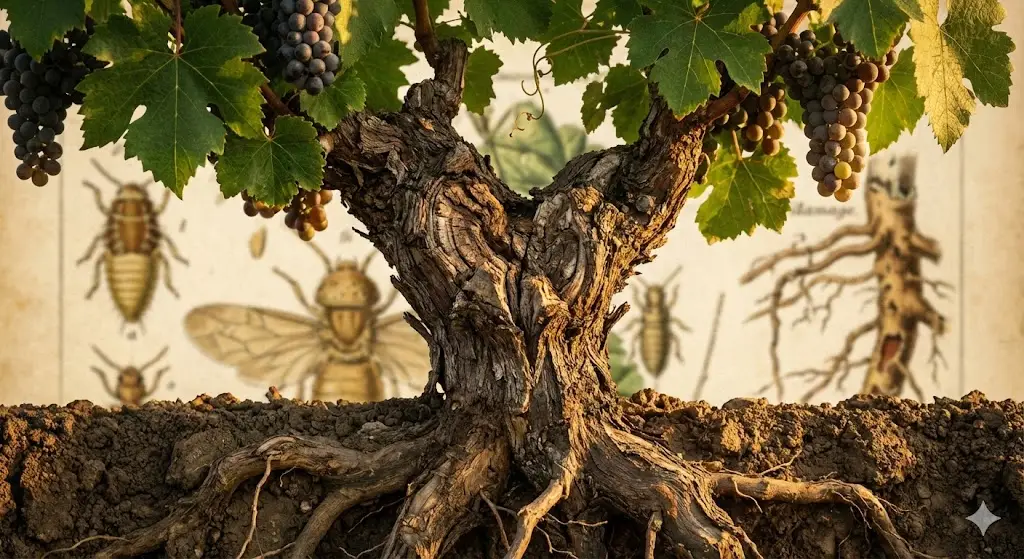
Imagine a world without Bordeaux, without Burgundy, without Beaujolais. This catastrophic scenario nearly became reality 150 years ago.
If you are enjoying a great French wine today, you owe it to an unexpected alliance — a biological “marriage of convenience” between the Old World and the New. Here is a fact few people know: 99% of French vines today grow on… American rootstocks.
Here is the scientific thriller that shook the wine world.
The Invisible Invasion: The Root Killer
It all started in the 1860s. A tiny louse from America — Phylloxera vastatrix — arrived in France unnoticed, most likely hidden in the holds of ships carrying exotic plants.
This serial killer was terrifying precisely because it was invisible: it lived underground and attacked the roots. On the surface, vines turned yellow and died, but nobody understood why. The devastation was nationwide: within a few decades, nearly 70% of French vineyards were destroyed.
Panic was total. As we tell in our “Vine Saviours” module, people tried everything to stop it — and sometimes the worst: flooding vineyards, injecting chemicals into the soil, and even… burying live toads under the vines to “absorb the poison”! Nothing worked.
The Solution from Across the Atlantic
Researchers eventually discovered a strange fact: wild American vines resisted the louse perfectly. They had learned to live with it over millennia.
But there was a major problem: wine produced from these American vines had a “foxy” (wild, gamey) taste that European palates — accustomed to the finesse of Pinot or Chardonnay — simply could not accept.
This is where the genius of local figures like Victor Pulliat (an ampelographer from Beaujolais celebrated in our museum) came in. He championed a revolutionary and controversial idea: grafting.
The concept? Create a two-part botanical “chimera”:
- Underground (the roots): Use an American rootstock as a shield against the insect.
- Above ground (the fruit): Graft the traditional French variety onto it, preserving the taste and identity of the wine.
A Scar That Saved History
This “omega graft” technique — a puzzle-shaped cut that interlocks the two woods — saved France’s winemaking heritage.
Even today, if you look carefully at a vine just above the soil, you will see a small bump — a scar. That is the graft point. It is the indelible mark of this historic alliance. All the delicacy of our wines literally rests on the ruggedness of an American cousin.
Only a handful of very rare plots on sandy soils (where the louse cannot travel) remain “own-rooted” — ungrafted, original.
Come See the Vine “Surgery” Up Close
How is this precision operation carried out? What did the tools of the era look like? In our “The Vine” room, you can observe a grafted vine cross-section up close and understand how two different woods fuse into one. You will also discover the portraits of these Beaujolais inventors who fought against prejudice to impose their solution.
A story of science, survival and ingenuity you absolutely must explore.
👉 Plan your historic visit to Le Petit Musée du Vin in Lyon.